Safety First: Important Guidelines for Your Christianson Systems Equipment
At Christianson Systems, safety is our top priority. Our pneumatic conveying equipment is designed with safety in mind, but proper operation is essential. Please review these important safety guidelines before operating any of our equipment.
Safety Notice – Important – Read this!
Before using your vac, it is your responsibility to read, understand, and follow all safety instructions in your operator’s manual. Make sure EVERYONE operating or near your vac understands and follows these safety instructions.
Remember, a safety-minded, informed operator is the most important safety aspect of your equipment. Accidents can be avoided. Do not risk injury or death — be certain that every operator is well acquainted with all safety recommendations and operating instructions.
Safety Alert Symbol
This symbol means ATTENTION! BE ALERT! YOUR SAFETY IS AT STAKE!
The Safety Alert Symbol identifies important safety messages on this page and on your equipment. Make yourself familiar with these messages. When you see this symbol, be alert to the possibility of serious injury or death. Follow the safety instructions given in your manual and on your equipment.
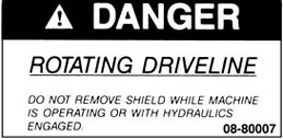
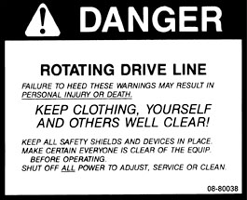
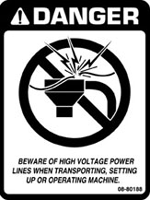
Safety Decals
READ AND BE CERTAIN THAT YOU FULLY UNDERSTAND THE MEANING OF ALL SAFETY DECALS BEFORE OPERATING YOUR EQUIPMENT. Keep safety decals clean and readable at all times. Replace any safety decals that become unreadable or are missing. If a part with an attached safety decal is replaced, make sure the proper safety decal is attached in the proper location on the replacement part. You may obtain new decals from your local dealer or contact us directly.


Equipment Operation Safety
Following proper safety procedures during equipment operation is essential for preventing accidents and injuries.
Starting Up Safety
PTO Equipment Safety
- Secure the tractor draw-bar in the center position.
- If you have a 1000 RPM PTO, set the tractor draw-bar so that the hitch pin is 16″ behind the end of the PTO shaft.
- If you have a 540 RPM PTO, set the tractor draw-bar so that the hitch pin is 14″ behind the end of the PTO shaft.
- CAUTION: Do not set the draw bar to a shorter length than recommended, as this could cause the telescoping members of the PTO shaft to exert excessive pressure on the gearbox.
- Securely attach the PTO shaft to the 1000 or 540 RPM shaft on your tractor, whichever is applicable.
- Be sure the tractor and vac drawbar are parallel to the PTO shaft.
- Fasten the jack in the horizontal position.
- Set open/close center hydraulic valve for open or closed center hydraulics to correspond to the hydraulic system on your tractor. FAILURE TO PROPERLY SET THIS VALVE COULD RESULT IN DAMAGE TO YOUR TRACTOR.
Self-powered and PTO Equipment Safety
- Be sure all shields are in place.
- Check for high-voltage power lines before raising the truck loading kit.
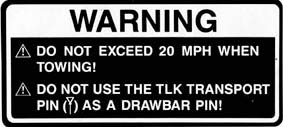
- Remove the transport pin from the truck loading kit before raising the upper elbow.
- Securely connect the safety latch for the truck loading kit before loading trucks.
- Wear suitable ear protection.
- Be sure all people are clear of the vac before starting up.
Operating Safety
Safe Operating Procedures
- Keep hands, feet and loose clothing away from the PTO or drive shafts, intake nozzles, machine discharge, air pump, machine cyclone access door and airlock discharge.
- Keep hands and all parts of body away from nozzle intake.
- Keep away from discharge side of air pump.
- Never operate your vac without all shields in place.
- Never open the machine cyclone access door while your tractor is running.
- Never remove the lower elbow from the truck loading kit while your tractor is running.
- Never operate your vac inside a building.
- Never inspect or service your vac without SHUTTING OFF THE TRACTOR OR ENGINE AND WAITING FOR ALL MOTION TO STOP.
- Never allow children to be near your vac.
- Wear suitable ear protection.
- Never leave your vac running unattended.
Shutdown Safety
Safe Shutdown Procedures
- Wait for all motion to stop before leaving operator’s position.
- Never stand under the truck loading kit while it is being lowered.
- Never inspect your vac without SHUTTING OFF THE TRACTOR OR ENGINE, WAITING FOR ALL MOTION TO STOP, AND DISCONNECTING THE PTO SHAFT.
Servicing Your Vac Safely
Service Safety
- Do not service the vac, including its hydraulic system, while it is running, while the tractor or engine is running, or with the PTO shaft connected.
- Never service your vac without SHUTTING OFF THE TRACTOR OR ENGINE, WAITING FOR ALL MOTION TO STOP, AND DISCONNECTING THE PTO SHAFT.
- Do not move any chain by hand.
- Remember, always shut off the tractor or engine and disconnect the PTO shaft before adjusting or repairing the conveyor.
- Do not insert your hand through the cyclone door or work on the airlock without first shutting off the tractor or engine, disconnecting the PTO shaft and removing the airlock drive chain.
- Wait for the air pump to cool before servicing.
Protect Against Noise
Hearing Protection Guidelines
- Prolonged exposure to loud noise can cause impairment or loss of hearing.
- Wear a suitable protection device, such as earmuffs or earplugs, to protect against objectionable or damaging loud noises.
Bin, Silo, and Tank Entry Procedures
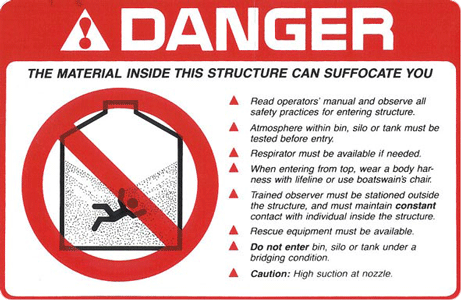
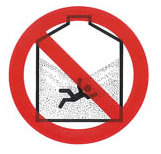
Entering a bin, silo, tank or other type of storage structure is hazardous. You can suffocate and die from the materials stored inside these structures. There also may be explosive, harmful or poisonous gas or dust in the air.
Safety Procedures for Storage Structure Entry
Before entering a storage structure, a vac operator and all other personnel assisting should strictly adhere to these safety procedures:
- The machine operator(s) and all assisting personnel should be aware of the actions they will take in the event of an emergency.
- The machine operator(s) and all assisting personnel should be trained in the general and specific safety hazards associated with their work tasks.
- The machine operator(s) and all assisting personnel should be trained in the general procedures and safety practices for entering and working in bins, silos, tanks or other storage structures, as well as the safety procedures for handling special tasks concerning entering and working in such structures.
- The atmosphere within a bin, silo, tank or storage structure should be tested for the presence of combustible gases, dusts, vapors and toxic agents.
- Ventilation should be provided until the unsafe conditions are eliminated or as long as there is a possibility of recurrence of the unsafe conditions while the bin, silo, tank or storage structure is occupied by personnel.
- If ventilation cannot eliminate the unsafe atmospheric conditions, anyone entering the bin, silo, tank or storage structure should wear an appropriate respirator and clothing.
- When entering bins, silos, tanks or storage structures from the top, personnel should wear a body harness with lifeline, or use a boatswain’s chair.
- An observer equipped to provide assistance and trained in rescue procedures, including notification methods, should be stationed outside the bin, silo, tank or storage structure being entered. Visual, voice or signal line communications should be constantly maintained between the observer and the party in the bin, silo, tank or storage structure.
- Equipment for rescue operations which is specifically suited for the bin, silo, tank or storage structure being entered should be provided.
- Do not enter bins, silos, tanks or storage structures under a bridging condition, or where a buildup of materials could fall and bury you. It is also recommended that you do not walk or stand on grain or other materials where the depth is greater than waist high.
- Be aware of the extremely high suction at the intake nozzle. Stay away from the nozzle intake area.
Bin Entry Do’s and Don’ts
When entering grain tanks, bins, and silos, follow these tips from the Kansas Grain and Feed Association’s Safety, Health and Environment Committee.
BIN ENTRY DO’S
- DO have a written entry permit completed by the supervisor.
- DO isolate all hazards of a mechanical, electrical, hydraulic, or pneumatic nature that could endanger an entrant. Isolation is accomplished by precautionary measures that include blocking off, disconnection, and lockout/tagout. Gates, conveyors, and other fill and reclaim equipment fall into this category.
- DO inform control room personnel of the intent to enter the bin, silo, or tank.
- DO lower the required equipment such as tools, lights, etc. on a separate rope prior to the entrant when entering from the top of a bin, tank, or silo.
- DO tie off whenever possible to the structure when working around the draw off or on top of the grain mass.
BIN ENTRY DON’TS
- DON’T discard entry permits until after entry operations have been completed.
- DON’T authorize entry until the atmosphere of a bin, silo, or tank has been assessed or tested for oxygen and any other known toxics or combustible gases.
- DON’T enter into a space for rescue without obtaining assistance first and having an attendant at the opening. Government statistics show that 60% of rescuers who do not take the time to get another attendant become fatalities themselves.
- DON’T issue permits without physically checking the space to be entered.
- DON’T allow permit times to extend beyond one work shift.
Have Questions About Safety?
Our team is here to help ensure you operate our equipment safely.
If you have any questions about safety procedures or need clarification on any of our guidelines, please don’t hesitate to contact us.

Let’s Find the Right Pneumatic Conveying Solution for You
From grain handling to industrial applications, we’ll design and
manufacture the perfect pneumatic conveying system for your needs.